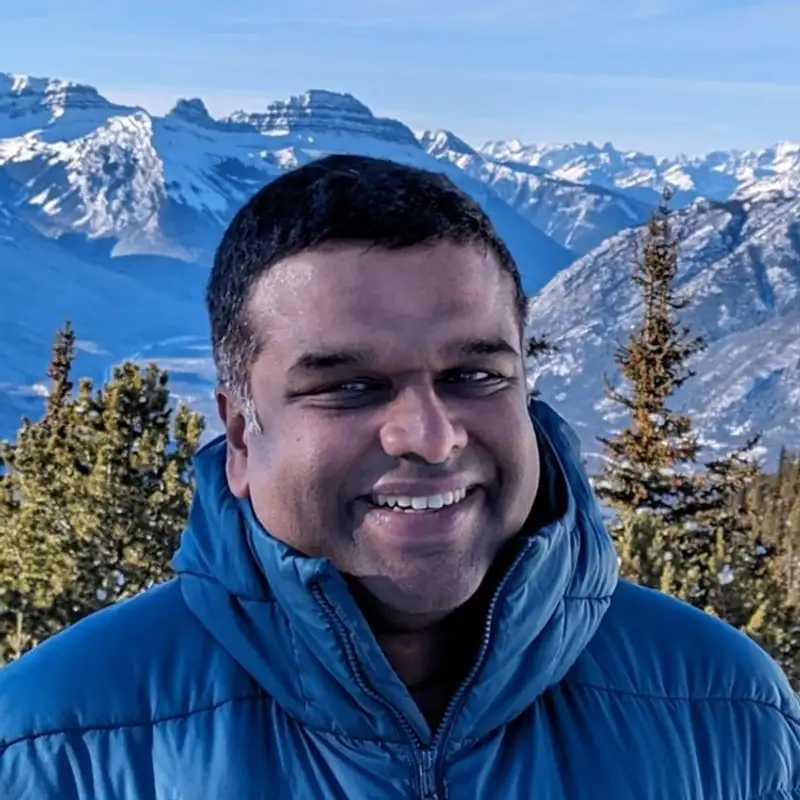
Joseph Modayil of Openmind Research Institute @ RLC 2025
Talk RL. Talk
Speaker 2:RL podcast is all reinforcement learning, all the time. Featuring brilliant guests, both researched and applied. Join the conversation on Twitter at talk r l podcast. I'm your host, Robin Chauhan. I'm here at RLC twenty twenty five at University of Alberta with Joseph Modayil, the founder, president, and research director of Openmind Research.
Speaker 2:Thank you so much for doing this, Joseph.
Speaker 1:Thank you for inviting me.
Speaker 2:Can you tell us some something about Open Mind Research? What is Open Mind Research, and what do you do?
Speaker 1:So, Open Mind Research is a Canadian nonprofit focused on research into understanding minds, and then sharing that understanding with everyone else.
Speaker 2:How how is Open Mind funded?
Speaker 1:So it's funded by donors who like the research division.
Speaker 2:If I understand, much of your research plan is driven by Rich Sutton's Alberta plan. Is that correct? Can you tell us a bit about the Alberta plan?
Speaker 1:Yeah. So, when discussing AI, or understanding intelligence, there's a variety of ways that people pursue it. Right? Even if we focus on reinforcement learning, there's various ways that people pursue that. So, the Alberta Plan is a more intentional, deeper dive into some of the fundamental problems that need to be addressed to improve our algorithms and our understanding of the computations involved in intelligence.
Speaker 2:So as we know, many people in the field are pursuing scaling LLMs as as possibly a holy grail or the one path to to to AGI or such. What what is your feelings about LLMs and able to how how do they might they or might not fit into into what you do?
Speaker 1:So LLMs aren't really figuring into my vision of intelligence. They're an interesting direction, and many people are pursuing them. But they don't explain for me the intelligence of a squirrel, for example. Right? They don't explain what drives our minds to go out and explore a world, to interact with it, to seek out and pursue its goals.
Speaker 2:To can you say anything about the the time horizon that your that you have in mind for this this work?
Speaker 1:So it's certainly not something that would finish in an ear. It could take a decade. It could take five decades. But I would be surprised if we haven't made substantial progress within a decade.
Speaker 2:Are are concepts like pre training and priors and offline data, are they relevant to to what you're doing?
Speaker 1:They're certainly not the focus. Right? I'm most interested in understanding how the development of the mind is driven internally. Right? So if I look at a child or if I look at a young animal that's going through the world, they're learning from trial and error experience.
Speaker 1:Right? That they do something, they see, oh, that worked out well. That didn't work out well. And so we might be baked in with a bunch of systems, and we might design our robots with a bunch of systems, but the fundamental process that's of interest, the part that we don't understand, is how to have complexity emerge from that stream of experience, like learning while you're doing.
Speaker 2:Does brain architecture or neuroscience influence influence how you
Speaker 1:see building proto AIs? There's a lot of inspiration that I draw from biology, but it's largely inspiration. Often, when the neuroscientists speak, they say, they explain to us that the way that our brains work is not the way that we naively think that they work. And we can see this in a variety of careful scientific experiments. And that opens our minds to the way that other minds might work.
Speaker 1:Right? So I find neuroscience and psychology incredibly inspiring and thought provoking, and I use that to drive my research forward. Thank you so much to Joseph Modayil. Thank you for having me.
Creators and Guests